The RTC Streets and Highways division oversees Motor Vehicle Fuel Tax and Question 10 funded roadway construction projects, including Fuel Revenue Indexing projects.
Learn More
Transportation Planning
Designated under federal law as the Metropolitan Planning Organization (MPO), the RTC is responsible for overseeing the transportation planning process for Southern Nevada.
Learn More
Innovations
The RTC and its partners continue to lead the way in testing and integrating new smart mobility technologies.
Learn More
Lights, Camera, Action!
Seeing Orange
On Board - Your Future Mobility Plan
On Board - Your Future Mobility Plan
Roadway Funding
Reimagine Boulder Highway
Budget
The RTC and its activities are funded through numerous sources.
View Our Budget
Apply for Bus/Paratransit Driver
Learn About RTC Culture
Doing Business With Us
The Regional Transportation Commission uses the regional supplier registration and e-bidding platform, Nevada Gov eMarketplace (NGEM). There is no charge to suppliers for using NGEM.
See Current Bid Opportunities
RTC Board Meeting
TAAC Meeting
EAC Meeting
Bus Shelter and Bench Advisory Committee
Our Leadership
The RTC is overseen by members of the Clark County Commission and city council members.
Learn More
Club Ride
Club Ride is a FREE program designed to improve air quality and encourage the use of commute alternatives to work such as carpooling, vanpooling, etc.
Learn More
Book Paratransit Trips Online
Call Before You Move
Learn About Tap Process
Silver STAR / FDR
Our Report Card
Our vision is to provide a safe, accessible, and efficient regional transportation network.
See How We're Doing
Subscribe to Route Alerts
Transit Watch App
Purchase Passes with rideRTC
Purchase Paratransit Passes
Las Vegas Strip Service
Airport Transit Routes
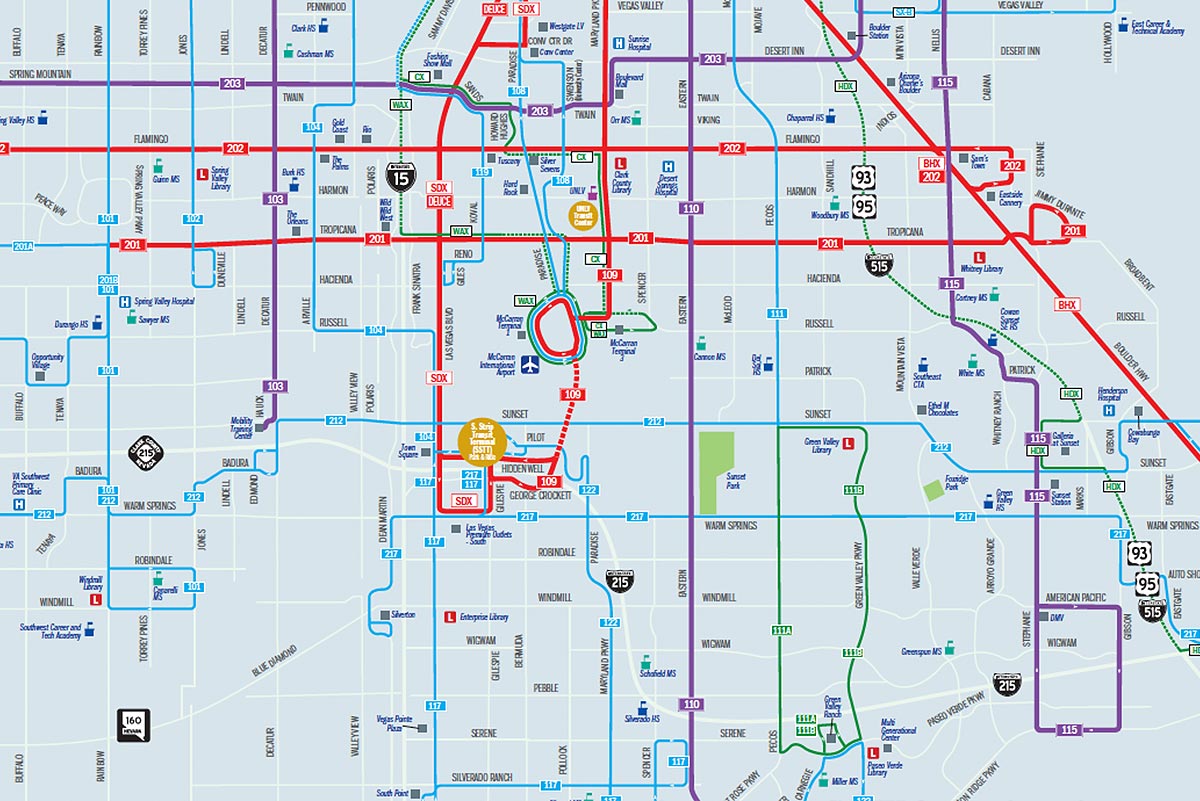
Schedules & Maps
July 2023 Service Change
Cycling
We are committed to developing a safe, connected, and convenient walking and bicycling system.
Check Out Our Programs
Southern Nevada Strong
Southern Nevada Strong is a collaborative effort to plan, create and sustain neighborhoods where residents can have access to quality education, a variety of housing choices, good-paying jobs and transportation options.
Visit Seeing Orange and plan your trip before you go.
Your one-stop location for up-to-the-minute traffic and transit alerts to help you plan your trip.
RTC of Southern NevadaRTC Web Admin2024-04-15T10:13:41-07:00
Route 103 (Decatur) is on a 24-hour detour due to active construction in the northbound lanes on Decatur Blvd.; from Tropicana Ave. to West Desert Inn Rd. MORE DETAILS.
Loading...
Be a Hero.
Ride Zero (emissions).
Click here to learn more
Let us take you to the game!
Check out the Game Day Express with 6 convenient pickup locations.
To provide the best experiences, we use technologies like cookies to store and/or access device information. Consenting to these technologies will allow us to process data such as browsing behavior or unique IDs on this site. Not consenting or withdrawing consent, may adversely affect certain features and functions.
Functional
Always active
The technical storage or access is strictly necessary for the legitimate purpose of enabling the use of a specific service explicitly requested by the subscriber or user, or for the sole purpose of carrying out the transmission of a communication over an electronic communications network.
Preferences
The technical storage or access is necessary for the legitimate purpose of storing preferences that are not requested by the subscriber or user.
Statistics
The technical storage or access that is used exclusively for statistical purposes.The technical storage or access that is used exclusively for anonymous statistical purposes. Without a subpoena, voluntary compliance on the part of your Internet Service Provider, or additional records from a third party, information stored or retrieved for this purpose alone cannot usually be used to identify you.
Marketing
The technical storage or access is required to create user profiles to send advertising, or to track the user on a website or across several websites for similar marketing purposes.